
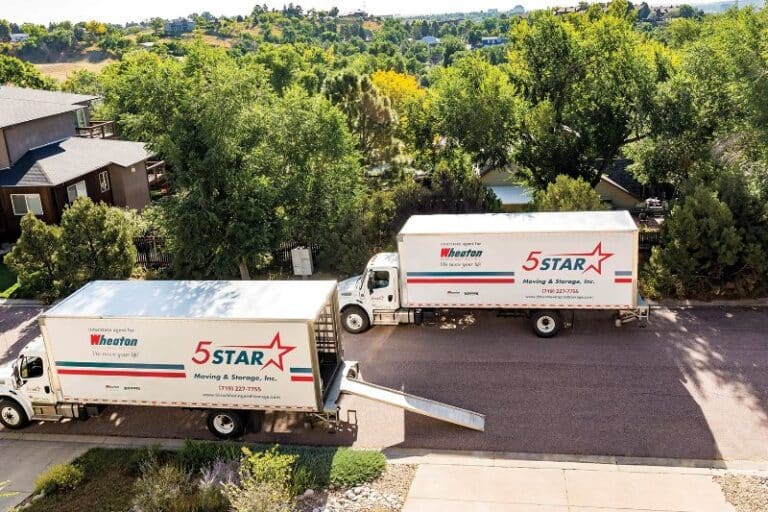
When people ask me about interstate movers vs local movers, the short answer is that once your belongings cross a state line, your move falls under federal rules, and the company hauling it has to follow them. An interstate mover needs a USDOT number, has to give you a written estimate based on actually seeing your things, and must hand you a federal booklet that spells out your rights. A move across Colorado Springs doesn’t come with that federal paperwork, and it’s usually priced a different way too. We’ve been doing both kinds of moves since I started 5 Star in 2007, so here is how they compare in plain terms.
Where the line actually falls
People sometimes assume a long drive makes a move interstate. The test is simpler than that. If your shipment leaves Colorado, the move is interstate, and if it stays in the state, it isn’t.
A move from Colorado Springs to Grand Junction covers a lot of road, but it stays inside the state, so it isn’t an interstate move. The same goes for heading up I-25 to Denver or down to Pueblo. A move from Pueblo to Raton, New Mexico, is a much shorter drive than the Grand Junction trip, and it is interstate, because it crosses the border.
In-state moves follow Colorado’s rules rather than the federal interstate ones. That doesn’t make them casual. You still want a written estimate, a clear explanation of how you’ll be charged, and a crew that knows what it’s doing. The specific federal requirements I describe below are the ones that apply once the truck heads out of state.
The rules that come with crossing a state line
Interstate household moves are overseen by the Federal Motor Carrier Safety Administration, which everyone in this business calls FMCSA. Every mover that hauls household goods across state lines has to have a USDOT number. Ours is 70719.
Before you hire anyone for an out-of-state move, look up their number and make sure it belongs to the company you think you’re talking to. It takes a few minutes, and it’s one of the easiest ways to weed out an operator you don’t want anywhere near your furniture. I wrote about other warning signs in five simple ways to spot a moving company scam.
The mover also has to give you a written estimate, and that estimate has to be based on an inspection of your household, either in person or by video. A number someone tosses out over the phone after asking how many bedrooms you have is a rate quote. Under the federal rules, a rate quote is not an estimate, and you shouldn’t plan your budget around one.
Finally, interstate movers have to give you FMCSA’s booklet, “Your Rights and Responsibilities When You Move.” I know it’s tempting to set it aside with the rest of the paperwork. Please read it. It explains what your estimate means, what happens at delivery and what you can do if something goes wrong, and it’s written in plain language for customers.
Binding and non-binding estimates
On an interstate move, your written estimate will be one of two kinds, and the difference matters most on the day the truck pulls up at your new home.
A binding estimate sets the total. You won’t pay more than the estimated amount at delivery. If you add items or services after it’s written (say you remember a storage shed full of tools, or you decide you’d like us to pack the kitchen after all), the mover prepares a new binding estimate to cover the change.
A non-binding estimate is the mover’s best calculation, and it can move. The final cost depends on the actual weight of your shipment, the services you used and the mover’s tariff. There is a protection built in, though. At delivery, the mover can’t require you to pay more than 110 percent of the non-binding estimate. That rule exists so nobody ends up standing at the curb with a bill far bigger than the one they planned for.
Which one suits you depends on how settled your plans are. In my experience, families who have already sorted, sold and donated before the survey get the most out of a binding estimate, because what we see is what actually goes on the truck. Whoever comes to your home should explain both options, and the type of estimate should be written on the paperwork.
How each kind of move is priced
Local moves are usually priced by time and crew size. The clock and the number of movers drive the bill, so anything that slows a crew down shows up in the total: stairs, a long walk from the front door to the truck, a dresser that’s still full, boxes that haven’t been taped. That’s why I tell local customers that being packed and ready when the crew walks in is the best way to keep the cost where they expect it. Our local moving service page explains what our crews handle around town.
Interstate moves are generally priced mainly on the weight of the shipment and the distance it travels, plus services like packing and storage. Hours on the clock matter much less. That’s why an interstate survey focuses on what you own. We look at the furniture, the closets, the garage, the basement shelves and the things tucked under the stairs. Every box you sell or donate before the survey is a box you aren’t paying to haul across the country, so that’s the time to be ruthless.
Carrier, agent and broker: who is actually moving you
This is where a lot of confusion starts, and where some people get burned.
A carrier is the company with the authority and the equipment to haul household goods across state lines. Wheaton World Wide Moving is a national van line with a network that reaches every state.
An agent is a local moving company that works inside a van line’s network. 5 Star is the Wheaton agent here in Colorado Springs. When you book a long distance move with us, our people come to your home for the survey, our crews pack and load your things, and Wheaton’s nationwide network carries the shipment to your new state. You deal with one local team from the first conversation through delivery. Our Wheaton agent page explains how that partnership works.
A broker is a different animal. A broker sells you the move and then hands it to another company to perform. Some brokers are honest, but the arrangement means the person who quoted your move may never touch your belongings, and you may not know who’s coming until the truck shows up. I went into more detail on that in moving brokers vs. moving companies. When you move with us, there’s no handoff to a broker.
Questions to ask before you book
If you’re interviewing movers for an out-of-state move, these five questions will tell you a lot in a short phone call.
- What is your USDOT number, and does it match your company name?
- Will you inspect my home, in person or by video, before giving me a written estimate?
- Is the estimate binding or non-binding?
- Will your own crews pack and load my things, or are you arranging the move with someone else?
- When will I get the “Your Rights and Responsibilities When You Move” booklet?
A good mover answers every one of these without hesitating. If someone gets vague on any of them, keep looking.
Which kind of mover do you need?
If you’re moving anywhere inside Colorado, from Black Forest to Castle Rock or Woodland Park to Pueblo, you need a solid local or in-state mover who will be straight with you about time, crew size and access. If anything you own is leaving the state, you need a mover with interstate authority and a USDOT number, and you’re entitled to everything the federal rules require. Some companies only do one or the other.
We do both. Our crews are out on local moves all week, and our long distance moving service covers families leaving Colorado Springs for anywhere in the country. It’s the same local team either way, so a move to Monument and a move to Maine get the same care and the same people answering your questions.
If you aren’t sure which side of the line your move falls on, or you’d like a written estimate from the people who will actually do the work, ask us for a free, no-obligation moving estimate. I’m glad to walk you through it.
– Melysa