
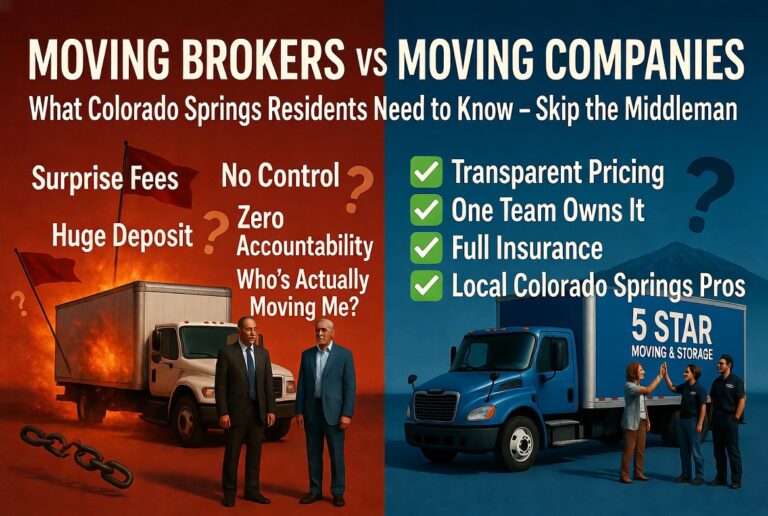
If you’ve started shopping for movers in 2026, you’ve probably noticed how polished everything looks online. Slick websites, instant quotes, virtual surveys, it all feels seamless. But here’s the thing: not every company giving you a quote actually owns a truck. Many of them are moving brokers, and if you don’t know the difference, you could end up paying more, stressing more, and trusting your belongings to a crew you never vetted.
We see it all the time here in Colorado Springs. Someone calls us after a broker experience went sideways, surprise fees, a no-show crew, or a deposit that disappeared into thin air. It’s frustrating, and it’s preventable. So let’s break down the real differences between moving brokers and moving companies, what to watch for, and how to make the smartest choice for your next move.
What Is a Moving Broker?
A moving broker is essentially a middleman. They don’t own trucks, don’t employ movers, and won’t be the ones carrying your couch down three flights of stairs. What they do is collect your move details, origin, destination, and inventory, then shop that job out to actual moving carriers.
Sounds convenient, right? In theory, brokers can quickly connect you with available movers, especially for long-distance relocations. But the reality is muddier. Once you sign with a broker, they hand your job off to whichever carrier accepts it. You might not know which carrier it is until moving day. And by then, the broker’s already collected their cut, often as a hefty upfront deposit.
The biggest issue? Moving brokers aren’t bound by the same accountability standards as the company physically handling your stuff. They quote one price to win your business, but the actual mover may charge a different price once they see your load in person. That disconnect is where most horror stories begin.
It’s also worth noting that brokers have gotten much harder to spot since 2020. Their websites look just as professional as any legitimate moving company, complete with customer reviews, branded trucks in stock photos, and reassuring language about “full-service” moves. But behind the curtain, they’re booking carriers they may have never worked with before.
What Is a Moving Company?
A moving company is the real deal, they own the trucks, employ the crews, and physically handle your belongings from pickup to delivery. When you hire a moving company directly, you’re working with the same team throughout the entire process. No handoffs, no mystery subcontractors.
At 5 Star Moving & Storage here in Colorado Springs, that’s exactly how we operate. We’ve been serving our community since 2007, handling residential moves, commercial relocations, long-distance moves, and even military-approved DoD shipments. As an Interstate Agent for Wheaton World Wide Moving, we’re backed by a nationwide network of resources, but we’re still the ones showing up at your door, packing your boxes, and driving your belongings to their destination.
A direct moving company handles everything: packing with high-quality materials, loading, transportation, unloading, and even storage if needed. You get a personal coordinator, transparent pricing, and clear communication from start to finish. There’s no guessing about who’s responsible if something goes wrong, because it’s us. We carry proper insurance and offer multiple levels of moving protection so you can choose what fits your comfort level.
That kind of accountability simply isn’t possible when a broker is in the middle.
How Moving Brokers and Moving Companies Differ
On the surface, moving brokers and moving companies can look identical. But dig a little deeper, and the differences are significant, especially when it comes to your wallet, your peace of mind, and your legal protections.
Pricing and Transparency
Brokers are notorious for lowball quotes. They dangle an attractive number to get you to sign, knowing full well the actual carrier might charge more once they assess your load. Since the broker isn’t handling the move, they can’t guarantee the final cost. That “estimate” you got? It’s more of a suggestion.
With a direct moving company, pricing is based on an actual assessment of your belongings, whether that’s an in-home walkthrough or a detailed virtual survey. We know our trucks, our labor costs, and our routes. When we quote you a price at 5 Star Moving & Storage, it reflects the actual cost of the move. No balloon payments after the fact.
Communication and Accountability
Here’s where the frustration really builds with moving brokers. Once they’ve handed your job to a carrier, communication often falls apart. You call the broker with a question, and they point you to the carrier. You call the carrier, and they barely know your name. Nobody owns the problem.
When you work directly with a moving company, there’s one point of contact. One team. You can call us, get real answers, and adjust your plan if something changes. Every move we handle gets a personal coordinator, which means you’re never left chasing someone down for updates on your shipment.
Liability and Insurance Coverage
This is the one that catches people off guard. Brokers typically aren’t liable for damage to your belongings during transit, because they’re not the ones moving them. If something breaks, you’re dealing with the carrier, a company you didn’t choose and may not have even heard of before moving day.
A licensed moving company carries its own insurance and offers protection plans you can review before signing anything. We offer basic Limited Liability coverage on every move, plus optional Added Valuation and Full Value policies for customers who want extra peace of mind. You know exactly who’s responsible and where to go if there’s an issue.
Pros and Cons of Using a Moving Broker
Let’s be fair, brokers aren’t all bad in every scenario. Here’s an honest look:
Potential Pros:
- Can sometimes find available carriers quickly, especially during peak season
- May offer convenience for people who don’t want to research multiple companies
- Occasionally useful for last-minute moves when local options are booked
Significant Cons:
- No control over who moves your stuff. The carrier assigned to your job is whoever accepted it, not necessarily the best- or most-qualified.
- Surprise price increases. That low quote was bait. The actual mover often charges more after seeing the real scope of the job.
- Large upfront deposits. Brokers frequently require substantial non-refundable deposits, even if the move falls through.
- Zero accountability after handoff. Once the broker passes your job along, they’re largely out of the picture. Good luck getting them on the phone.
- Harder to file claims. Damage disputes become a finger-pointing match between broker and carrier.
The bottom line? Brokers might save you a few minutes on the front end, but they can cost you real money, and real sanity, down the road. That lowball quote screaming “too good to be true” almost always is.
Pros and Cons of Hiring a Moving Company Directly
Going direct has clear advantages, though it does require a bit more legwork upfront.
Pros:
- Full transparency. You know exactly who’s handling your move, what it costs, and what’s included.
- Consistent communication. One team, one point of contact, real answers when you call.
- Proper insurance and liability coverage. The company moving your belongings is the same one insuring them.
- Professional crews who know the job. Our movers at 5 Star Moving & Storage are trained to handle everything from fragile glassware to heavy office equipment, and they show up prepared.
- Flexible services. Need full-service packing? Just loading and unloading? Long-term storage? A direct company can customize the plan to your needs.
- Accountability you can count on. If something goes wrong, there’s no middleman to hide behind.
Cons:
- You may need to get quotes from a few companies to compare (but honestly, that’s time well spent)
- During peak moving season, reputable companies book up, so planning ahead helps
For Colorado Springs residents, working with a local company like ours means you also get someone who knows the area, understands the unique challenges of Colorado moves, like altitude, weather, and mountain passes, and genuinely cares about their reputation in this community.
How to Spot Moving Brokers Scam
Brokers have gotten craftier, but there are still telltale signs if you know where to look:
- They won’t do an in-home or virtual survey. Legit moving companies want to see what they’re moving. Brokers just need your zip codes and a rough inventory to generate a quote.
- The quote feels too low. If it’s dramatically cheaper than every other estimate, that’s not a deal, it’s a trap.
- They demand a large deposit before anything happens. Reputable movers don’t typically require massive upfront payments.
- The contract says “broker” somewhere in the fine print. Read every document. FMCSA requires brokers to disclose their status, but it’s often buried.
- They can’t tell you which company will actually move you. Ask directly: “Will your employees be handling my belongings?” If the answer is vague, walk away.
- Their USDOT number reveals broker authority, not carrier authority. You can verify this on the FMCSA website. It takes two minutes and could save you thousands.
One more thing, check reviews carefully. Brokers often have glowing reviews for the quoting process but terrible ones for the actual move. That pattern is a dead giveaway.
How to Choose the Right Option for Your Move
Whether you’re relocating across Colorado Springs or heading out of state entirely, here’s how to protect yourself:
- Verify credentials. Look up the company’s USDOT number and confirm they hold carrier authority, not just broker authority.
- Get an in-home or virtual estimate. Any company willing to give you a binding quote based on an actual assessment of your belongings is far more trustworthy than one quoting blindly.
- Ask who’s doing the moving. This single question eliminates most broker confusion. If they hedge, you have your answer.
- Read the contract thoroughly. Look for broker disclosures, deposit terms, and cancellation policies before signing anything.
- Check local reputation. A company rooted in your community, with real reviews from real neighbors, has far more at stake than an out-of-state broker.
- Compare quotes, but don’t chase the cheapest number. The lowest price often comes with the highest risk.
We always tell folks: your move is one of the most stressful life events you’ll go through. The last thing you need is a middleman adding to the uncertainty of an already chaotic process. At 5 Star Moving & Storage, we’ve spent nearly two decades building trust in Colorado Springs, handling residential moves, commercial relocations, military shipments, and everything in between. We’re licensed, insured, BBB A+ rated, and Silver Certified for senior moves. When you call us, you’re talking to the people who’ll actually be moving you.
Conclusion
Moving brokers and moving companies might look the same from a search results page, but the experience couldn’t be more different. Brokers add a layer of risk, opaque pricing, unknown carriers, and vanishing accountability, which most people don’t realize they’ve signed up for until it’s too late.
Going direct with a real moving company means you know who’s showing up, what you’re paying, and who to call if plans change. It’s straightforward, and honestly, it’s how moving should work.
If you’re planning a move in Colorado Springs or anywhere across Colorado, we’d love to help. Reach out to 5 Star Moving & Storage for a free, no-obligation quote and see what working with a real moving company feels like. Your belongings and your peace of mind deserve better than a middleman.
Frequently Asked Questions About Moving Brokers vs Moving Companies
What is the difference between a moving broker and a moving company?
A moving broker is a middleman who collects your move details and outsources the job to a third-party carrier—they don’t own trucks or employ movers. A moving company, like 5 Star Moving & Storage, owns its equipment, employs trained crews, and handles your belongings directly from pickup to delivery, ensuring full accountability and transparent pricing.
How can I tell if I’m dealing with a moving broker or an actual mover?
Ask directly whether their own employees will handle your belongings. You can also look up their USDOT number on the FMCSA website to check for carrier authority versus broker authority. Brokers often skip in-home surveys, offer unusually low quotes, and require large non-refundable deposits—all red flags to watch for.
Why are moving broker quotes often cheaper than moving company quotes?
Moving brokers frequently use lowball estimates to win your business, knowing the actual carrier may charge significantly more once they assess your load in person. A direct moving company bases its quote on a real evaluation of your belongings—through an in-home walkthrough or virtual survey—so the price reflects the true cost of your move.
What should I look for when choosing a moving company for an interstate move?
Verify the company holds carrier authority through FMCSA, request an in-home or virtual estimate, and confirm they offer insurance and protection plans. A company like 5 Star Moving & Storage, an Interstate Agent for Wheaton World Wide Moving, provides nationwide resources, personal move coordinators, and multiple levels of moving protection for long-distance relocations.
Who is liable if my belongings are damaged during a move arranged by Moving brokers?
Brokers typically aren’t liable for transit damage since they don’t physically handle your items. You’d need to file a claim with the assigned carrier—a company you may not have chosen or even known about beforehand. Hiring a direct moving company ensures the same team moving your belongings also insures them, with clear protection options like Limited Liability, Added Valuation, or Full Value coverage.
What services does a full-service moving company include that Moving brokers cannot guarantee?
A full-service moving company handles packing with quality materials, loading, transportation, unloading, storage, and even specialty crating—all under one roof. They assign a personal coordinator for consistent communication throughout. Moving brokers can’t guarantee service quality, crew professionalism, or consistent pricing because they pass your job to whichever carrier accepts it.